
The Flamingos Came Back to Florida. This Time, Some of Them Stayed.
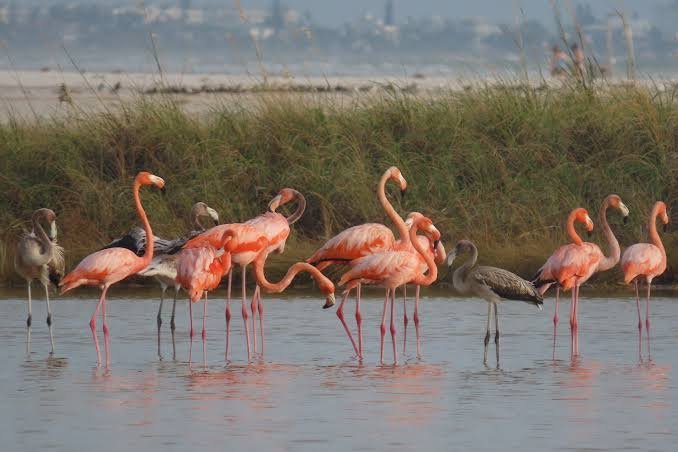
For generations, the flamingo has occupied a peculiar place in Florida culture. Its image is everywhere: on hotel signs, postcards, restaurant walls, tropical prints and the plastic lawn ornaments that became an almost comic shorthand for life in the Sunshine State. Yet seeing an actual wild flamingo in Florida has, for most modern residents, been something entirely different. The birds seemed to belong more naturally to the Caribbean, while Florida claimed their likeness.
History tells a more complicated story. Long before the pink plastic version became an emblem of Florida kitsch, wild American Flamingos were part of the landscape of South Florida. Historical accounts describe flamingos gathering in Florida Bay during the 19th and early 20th centuries, sometimes in remarkable numbers. A scientific review published in 2018 examined those records and concluded that the American Flamingo should be considered part of Florida’s native avifauna rather than dismissed simply as an occasional escaped exotic bird. Audubon notes that flocks from the Bahamas regularly migrated into Florida Bay until around 1900. (BioOne)
Then they largely disappeared.
The reasons echo the history of many of South Florida’s great wading birds. During the plume-trade era of the late 19th century, brilliantly colored feathers became enormously valuable in the fashion industry. Flamingos and other birds were hunted, while the wetlands they depended upon were subsequently altered by decades of drainage, development and changes to the natural flow of the Everglades. Flamingos became increasingly rare in Florida, to the point that later sightings were often assumed to be birds that had escaped from zoos or private collections. (Audubon)
Then Hurricane Idalia arrived.
In late August 2023, Idalia traveled between the Yucatán Peninsula and western Cuba before making landfall in Florida’s Big Bend as a Category 3 hurricane. Somewhere along that journey, its enormous circulation appears to have encountered American Flamingos, most likely birds associated with populations in Mexico and Cuba. The storm carried them northward and scattered them across an extraordinary geographic area. Flamingos appeared throughout Florida, but sightings were also recorded in places where the bird seemed almost surreal: Alabama, the Carolinas, Tennessee, Texas and even as far north as Wisconsin and Pennsylvania. (Audubon)
Florida had experienced storm-blown flamingos before, but scientists described the scale of the Idalia event as unprecedented. Suddenly, more than 100 flamingos were being discussed across the state. They appeared from the Panhandle to Southwest Florida and South Florida, standing in shallow coastal water in scenes that looked less like an ecological anomaly than a photograph from Florida’s distant past. (Audubon)
The obvious assumption was that they would eventually leave.
Many did. But some did not.
In February 2024, Audubon Florida organized a statewide census with the Florida Flamingo Working Group as part of a larger Caribbean-wide effort to count the species. More than 40 participants documented 101 wild American Flamingos still in Florida. More than 50 were observed in Florida Bay, 18 were recorded around Pine Island and another 14 were counted at Merritt Island National Wildlife Refuge. Researchers cautioned that 101 was not necessarily the entire population; it was simply the number they were able to document during the survey period. (Audubon)
Months later, the evidence that at least some of the birds had settled in became even harder to dismiss. In November 2024, a flock of 62 flamingos was observed in Florida Bay. For conservationists, the question had shifted. Instead of asking when the hurricane refugees would leave, they could begin asking whether some might stay. (Audubon)
That possibility has significance far beyond the novelty of seeing a spectacular pink bird in the Everglades. Florida Bay contains the shallow, productive wetlands flamingos use for feeding, and scientists have been studying whether restoration of the greater Everglades ecosystem could once again provide enough healthy habitat for them to persist here. Decades of work are attempting to restore more natural freshwater flows through the Everglades and into Florida Bay, correcting some of the enormous hydrological changes humans made to South Florida during the 20th century. Flamingos have arrived in a landscape that is still deeply altered, but one that is also the subject of one of the largest ecosystem restoration efforts in the world. (Audubon)
There is an intriguing ecological question hidden inside their return. If flamingos can find sufficient food, suitable water conditions and undisturbed habitat in Florida, their ability to remain could offer another measure of the health of South Florida’s wetlands. Wading birds are particularly sensitive to changes in water depth, salinity, food availability and the timing of wet and dry seasons. Scientists already use the breeding success and distribution of other wading birds to understand how the Everglades is responding to environmental change and restoration.
But remaining in Florida and reestablishing a breeding population are very different things.
American Flamingos are highly social birds that reproduce in colonies, constructing distinctive mud nests in shallow wetlands. Researchers have been watching Florida’s new arrivals for signs that they might eventually breed, but the establishment of a self-sustaining nesting population would represent a much more consequential development than a flock simply remaining for several years. Audubon researchers have said they are continually monitoring for evidence of breeding. (Audubon)
There is also a larger story unfolding beyond Florida. American Flamingos occur across the Caribbean, Mexico and parts of northern South America, and their overall population has recovered considerably from historic lows. Audubon reports that the global population is now estimated at more than 200,000 birds. But researchers remain concerned about the concentration of those birds into a declining number of functioning breeding colonies. Hurricanes, storm surge, human disturbance and habitat changes can have an outsized impact when large portions of a species depend on relatively few nesting locations. A viable Florida population, if one eventually develops, could therefore represent more than a local conservation success. It could provide another foothold for the species. (Audubon)
For South Floridians, there is something almost poetic about the possibility. We have spent decades putting flamingos on everything while the actual birds were largely absent from the landscape that helped inspire the association. Now, through the unlikely intervention of a hurricane, more than a century of conservation efforts elsewhere in their range and perhaps improving conditions in parts of the Everglades, wild flamingos have been given another opportunity to test Florida for themselves.
No one yet knows whether this marks the beginning of a permanent comeback. The birds may move elsewhere, their numbers may fluctuate, and a true breeding population has not yet been established. Scientists are watching precisely because the outcome remains uncertain.
But for now, when a flock of American Flamingos rises above the shallow waters of Florida Bay, the sight is not simply Florida living up to its own tropical mythology. It is a glimpse of something that once existed here, disappeared, and may be finding its way back.
The flamingo, it turns out, was never just a Florida mascot. It was a Floridian.