Miami Has a Rail Line to PortMiami. Could It Carry Passengers Too?
On a busy cruise weekend in Miami, the scale of PortMiami can be felt well beyond Dodge Island. Thousands of passengers arrive and depart within hours, moving between cruise terminals, Miami International Airport, hotels and destinations across South Florida. Most make that journey by road, adding taxis, rideshares, buses and private vehicles to an urban transportation network already carrying residents, commuters and visitors through Downtown Miami and the neighborhoods immediately to its north.
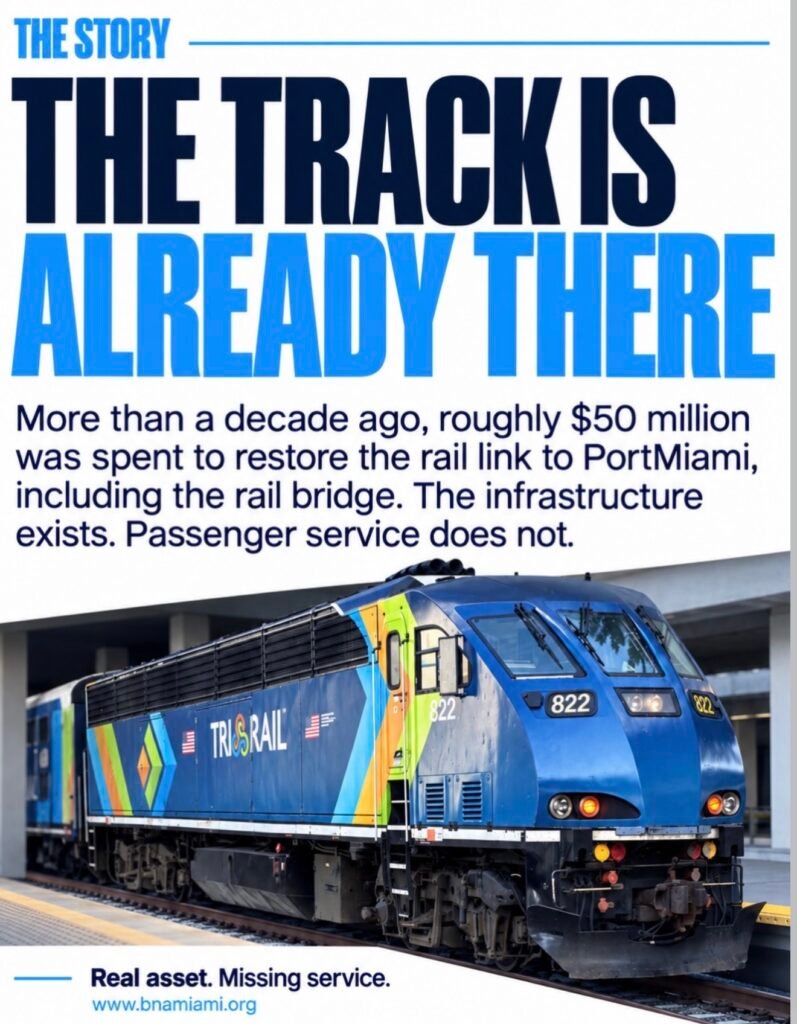
What is less visible from behind the wheel is that another transportation route into the port already exists. More than a decade ago, nearly $50 million was invested in restoring the rail connection between PortMiami and the Florida East Coast Railway network. The project rehabilitated the rail bridge connecting Dodge Island to the mainland, repaired tracks and signals and constructed new rail infrastructure inside the port. Service resumed in 2014, giving cargo moving through PortMiami direct access to the national freight rail network.
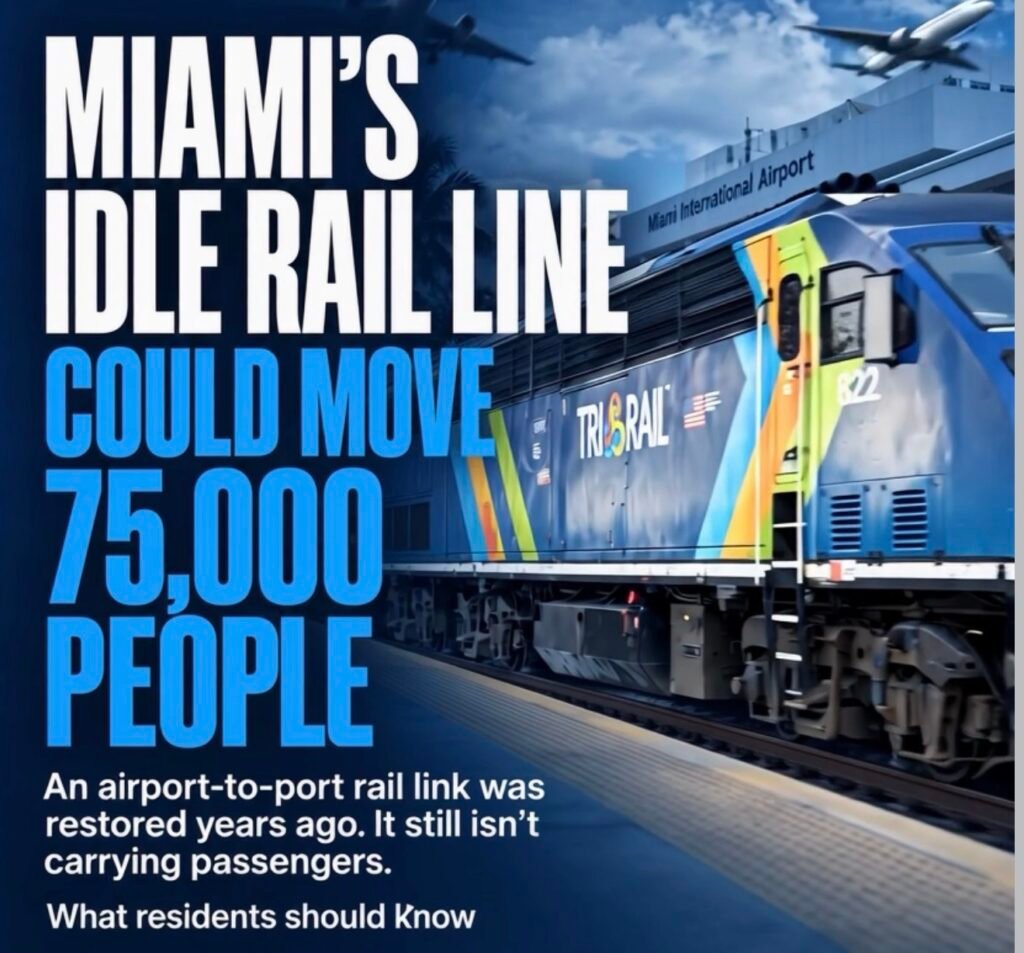
The line is not abandoned, despite the shorthand sometimes used in discussions about the project. It carries freight today. What it does not carry is passengers, and that distinction has become the basis of a new transportation proposal: use infrastructure already reaching one of the world’s busiest cruise ports to bring passenger trains there as well.
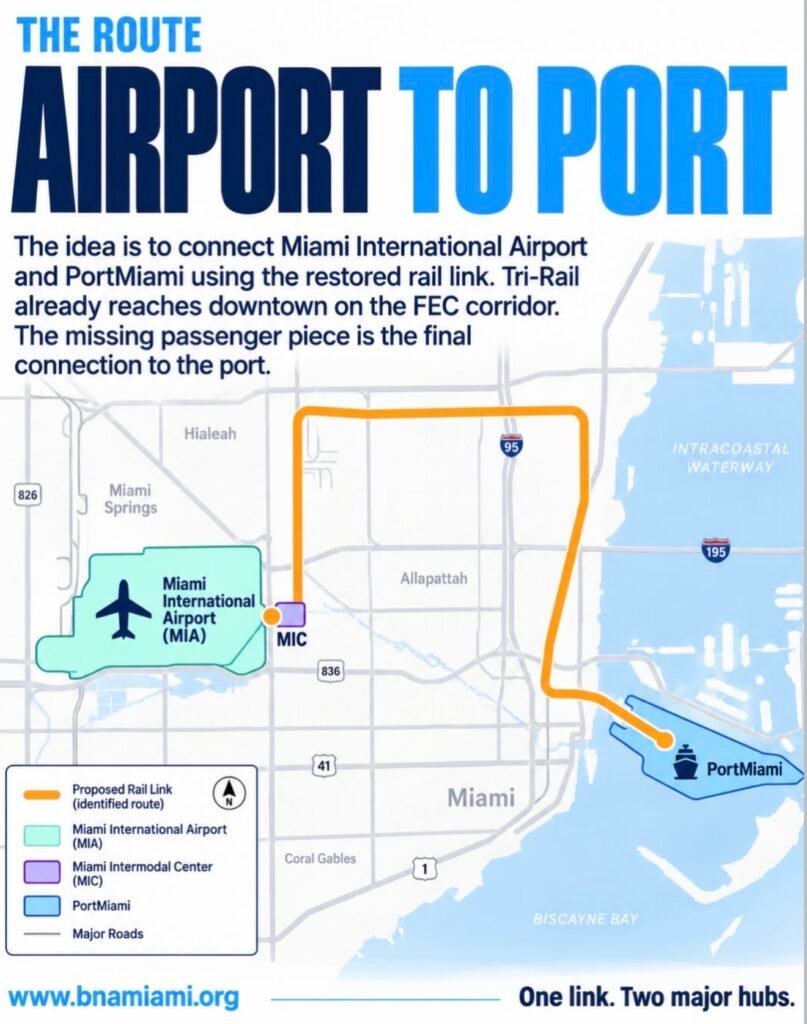
The idea has been championed by Miami-Dade County Commissioner Raquel Regalado, who also chairs the South Florida Regional Transportation Authority, the agency that operates Tri-Rail. Her proposal calls for establishing passenger rail service to PortMiami and constructing a station at the port, potentially creating a direct rail connection for travelers moving between Miami International Airport and their cruise terminals. Regalado has estimated the station component at approximately $33 million and has suggested that Miami International Airport and PortMiami could share the expense through revenues generated by those facilities. That funding structure remains a proposal rather than an approved financing plan.
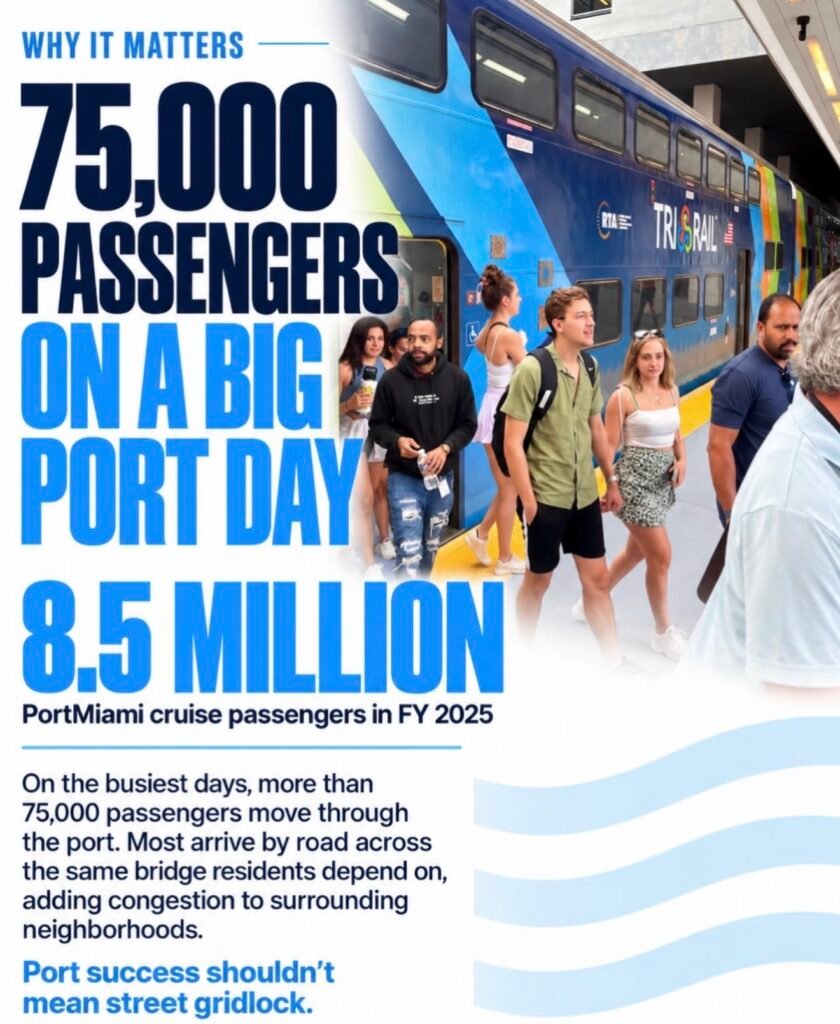
The argument arrives at a moment when the number of people moving through PortMiami has reached extraordinary levels. The port recorded more than 8.5 million cruise passengers during the 2025 fiscal year, according to Miami-Dade County, setting another annual record. On particularly busy days, the concentration is even more striking. Tourism data reported more than 81,000 passenger movements through PortMiami on April 4, 2026 alone. Those figures do not translate directly into an equivalent number of cars, but they illustrate the scale of the transportation challenge created when tens of thousands of people converge on a relatively small island connected to the mainland by a limited number of roadways.
For neighborhoods such as Edgewater, the question is not simply how efficiently tourists reach a cruise ship. Port traffic exists within a larger transportation system. Vehicles traveling to and from the port mix with commuters heading Downtown, residents using Biscayne Boulevard and surrounding streets, visitors traveling to Miami Beach and traffic generated by the continuing growth of Downtown, Wynwood, Midtown and the Design District. A transportation improvement at the port, depending on how it is designed and used, could therefore have effects beyond the port itself.
There are, however, substantial differences between having railroad tracks and having a functioning passenger service. A PortMiami station would require more than allowing a Tri-Rail train onto existing freight infrastructure. Passenger operations would have to be coordinated with freight movements, and questions involving station design, security, scheduling, accessibility and connections between a rail station and individual cruise terminals would need to be resolved. Cruise passengers also travel with luggage, making the final portion of the trip particularly important. Regalado has discussed the possibility of eventually coordinating luggage transfers between the airport and cruise ships, but such a system has not been finalized.
The proposal is also part of a much larger rail conversation taking place in Miami-Dade County, one that has particular significance for Edgewater. Separate from the PortMiami concept is the Northeast Corridor, a proposed commuter rail service running approximately 13.5 miles along the existing Florida East Coast Railway corridor between Downtown Miami and Aventura. Plans call for stations serving several communities along the route, including a Wynwood/Edgewater station, as well as stops associated with the Design District, Little Haiti, North Miami and the area near Florida International University’s Biscayne Bay Campus.
The two projects should not be confused. The Northeast Corridor is a major commuter rail initiative with its own planning, engineering, funding and federal approval process. The PortMiami proposal concerns extending passenger access onto the rail infrastructure serving the port. Yet together they point toward a broader change in the way Miami is beginning to think about transportation: not simply as a collection of isolated roads and transit projects, but as a network in which existing rail corridors might play a larger role.
That discussion is particularly relevant as the urban core continues to add residents and development. For decades, much of Miami’s growth has depended on a transportation system in which the automobile remains dominant. New residential towers, offices, hotels, entertainment districts and cruise terminals can increase economic activity and expand the city’s tax base, but they also generate additional trips. Widening roads in dense neighborhoods is often difficult, expensive or physically impossible, leaving policymakers with the challenge of moving more people through roughly the same amount of urban space.
Rail is not, by itself, a solution to Miami’s congestion, and a passenger station at PortMiami would not remove cruise traffic from Downtown streets. Its effect would ultimately depend on service frequency, convenience, pricing, connections and how many travelers chose to use it. Those details matter, particularly when public infrastructure and public money are involved. The proposal nevertheless raises a practical question: when Miami already has a rail connection reaching a destination that handles millions of passengers each year, should that infrastructure be examined as part of the region’s passenger transportation system?
For Edgewater, there is an additional reason to follow the debate. The same broader push toward passenger rail includes a proposed station bearing the Wynwood/Edgewater name. If that project advances, residents could eventually have access to a north-south commuter rail service linking the neighborhood with Downtown and communities farther north. At the same time, passenger rail to PortMiami could change how some of the millions of visitors passing through the urban core complete their journeys.
Neither project is a certainty, and both involve financial, operational and political decisions that remain unresolved. But Miami’s transportation debate is increasingly taking place against an unavoidable backdrop: the city is growing, the port is handling record numbers of passengers, and the streets connecting the urban core cannot grow indefinitely with them. The tracks are already there. The question now is what Miami chooses to do with them.
BNA will continue following the PortMiami passenger rail proposal, the Northeast Corridor and plans for the Wynwood/Edgewater station as they develop.